







Kyoto at the Pace It Deserves
Kyoto is a city designed for walking. The historic districts — Gion, Higashiyama, the Philosopher’s Path, Arashiyama, the Imperial Palace area — are connected by quiet residential streets, temple approaches, canal paths, and the preserved lanes of the traditional neighbourhoods. The city’s temples, shrines, gardens, and cultural experiences are woven into a pedestrian landscape that reveals its character at walking pace — the details (a moss garden glimpsed through a gate, a stone basin, a bamboo fence, the creak of a wooden bridge) are visible only to those on foot.
A guided walking tour provides the narration that makes Kyoto’s subtleties comprehensible. Without a guide, a temple is a building and a garden is a landscape. With a guide, the temple’s Buddhist denomination, its architectural period, its role in Kyoto’s political and cultural history, and the aesthetic philosophy of its garden become accessible — and the walk between temples, through the residential streets, becomes a continuous narrative rather than dead time.
Walking Tour Routes
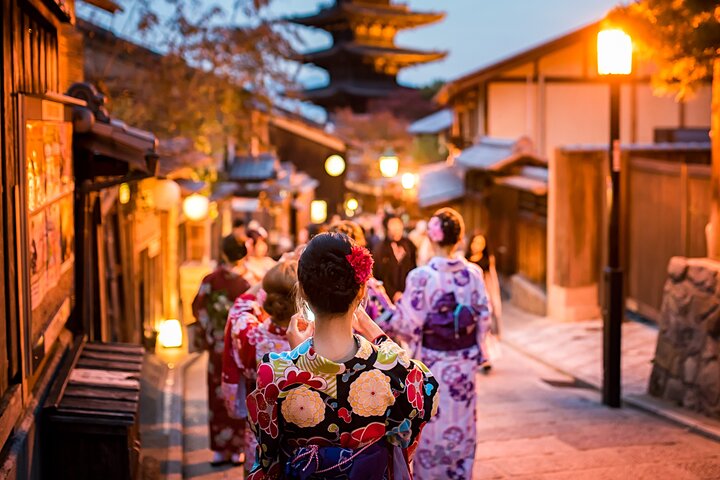
Higashiyama walking tour — the eastern temple district, from Kiyomizu-dera down through the preserved Sannen-zaka and Ninen-zaka lanes to Gion. The most popular walking tour route, covering Kyoto’s densest concentration of temples, traditional streets, and cultural atmosphere in 3–4 hours.
Philosopher’s Path (Tetsugaku no Michi) — a 2-kilometre canal-side walking path between Ginkaku-ji (Silver Pavilion) and Nanzen-ji temple, lined with cherry trees (spectacular in early April) and small temples and cafes. A gentle, reflective walk that takes 30–60 minutes for the path alone, extending to 2–3 hours with temple visits.
Arashiyama walk — the bamboo grove, Tenryu-ji temple, and the Sagano countryside (covered in the Arashiyama section).
Northern Kyoto walk — Kinkaku-ji (Golden Pavilion), Ryoan-ji (the famous Zen rock garden), and Ninna-ji temple — three UNESCO sites in the northwestern hills, connected by a 30-minute walk or a short bus ride between them.
Fushimi Inari walk — the torii gate trail up Mount Inari (covered in the Fushimi Inari section).
Frequently Asked Questions
How long is a Kyoto walking tour?
Most run 3–4 hours covering 4–6 kilometres. Half-day tours cover a single district (Higashiyama, Arashiyama, or northern Kyoto). Full-day walking tours combine two districts.
Is Kyoto flat for walking?
The city centre is flat. The temple districts (Higashiyama, Arashiyama, northern Kyoto) involve moderate hills and stone stairways. Fushimi Inari involves a mountain climb. The Philosopher’s Path is flat. Overall, Kyoto’s walking terrain is moderate — some hills and stairs but nothing extreme.
Do walking tours include temple entry fees?
Some tours include entry fees; others do not. Check the listing. Kyoto temple entry fees are typically ¥400–600 (approximately $3–4 USD) per temple.