

Ten Thousand Vermillion Gates
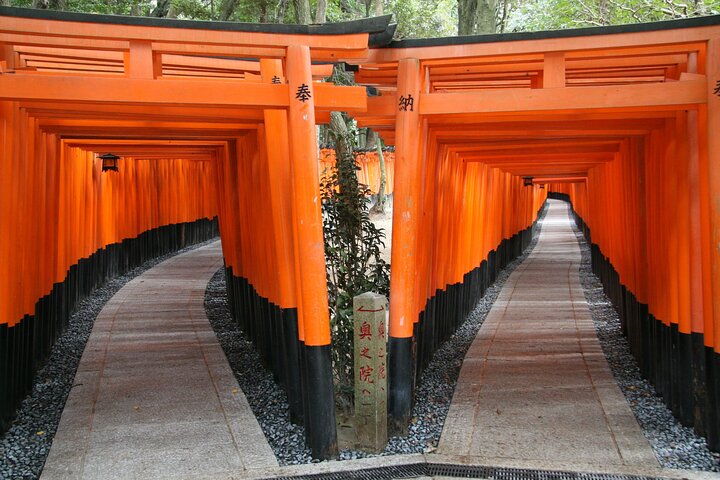
Fushimi Inari Taisha is a Shinto shrine in southern Kyoto famous for its senbon torii — thousands of vermillion-painted torii gates lining a network of trails that climb Mount Inari (233 metres) behind the shrine. The gates, donated by individuals and businesses seeking the blessings of Inari (the Shinto deity of rice, commerce, and prosperity), create a continuous tunnel of orange-red that winds through the forested mountain for approximately 4 kilometres. It is the single most visited tourist attraction in Japan (over 30 million visitors annually) and — despite the crowds — genuinely extraordinary.
The main trail from the base shrine to the summit of Mount Inari takes approximately 2–3 hours for the full return hike. The torii gates are densest on the lower sections (the first 30 minutes of climbing) and thin out as you ascend, with rest areas, sub-shrines, and viewpoints over Kyoto at intervals along the route. The higher you climb, the fewer visitors you encounter — the crowds are concentrated on the first few hundred metres.
What You Will See
The main shrine buildings at the base are the formal heart of Fushimi Inari — a large Shinto shrine complex with the haiden (worship hall), the inner sanctum, and the entrance torii. The shrine dates from 711 AD, predating Kyoto itself (the capital was moved here in 794).
The senbon torii (thousands of gates) begin immediately behind the main shrine and continue up the mountain. The gates range in size from large (tall enough to drive a car through) to small (barely taller than a person). Each gate bears the name and date of its donor and the amount paid. The visual effect — walking through a continuously enclosed tunnel of vermillion in dappled forest light — is the defining image of Kyoto.
The fox (kitsune) statues are everywhere — foxes are the messengers of Inari, and stone fox statues guard every sub-shrine, crossroads, and rest area on the mountain. The foxes carry keys (to rice granaries), jewels (representing the spirit of the deity), or scrolls in their mouths.
Yotsutsuji intersection (approximately 30–45 minutes from the base) is the main viewpoint — a clearing on the mountainside with a panoramic view across Kyoto to the western mountains. This is the turnaround point for most visitors who do not want to complete the full summit hike.
The summit of Mount Inari (233 metres) is reached after approximately 60–90 minutes of climbing from the base. The summit shrine is small and the view is obscured by trees, but the accomplishment of completing the full trail — and the near-emptiness of the upper sections compared to the crowded lower trail — rewards the effort.
Practical Tips
Visit at dawn for the fewest crowds and the best photographs. The shrine is open 24 hours and free. Arriving at 6:00–7:00 AM gives you the lower torii gates in near-solitude — the same section that has queues of tourists by 10:00 AM. The early morning light filtering through the gates is the most photogenic condition.
The climb involves stairs and uneven paths. Comfortable walking shoes are essential. The trail is paved with stone steps and packed earth — slippery when wet. Flip-flops and fashion shoes are inadequate.
Fushimi Inari is free and open 24 hours. No ticket, no timed entry, no closing time. This makes early morning and evening visits practical — the shrine at dusk, with the lanterns lit and the torii gates glowing against the darkening sky, is atmospheric.
Bring water and pace yourself. The full summit hike involves approximately 230 metres of elevation gain on stone stairs. In summer (July–August, temperatures 33–37°C with high humidity), the climb is physically demanding. Vending machines at rest areas along the trail sell drinks.
The lower sections are wheelchair accessible. The main shrine and the first section of torii gates are on relatively flat ground. The mountain trail beyond is stepped and not wheelchair accessible.
Frequently Asked Questions
How long does it take to walk the Fushimi Inari trail?
The full trail from the base shrine to the summit of Mount Inari and back takes approximately 2–3 hours. Walking to the Yotsutsuji viewpoint (the most popular turnaround point) takes approximately 30–45 minutes one way. The lower torii gate section (the most photographed area) is a 10–15 minute walk from the main shrine.
Is Fushimi Inari free?
Yes. The shrine is free to enter, open 24 hours, and requires no reservation. There is no admission charge at any point.
When is the best time to visit Fushimi Inari?
Dawn (6:00–7:00 AM) for the fewest crowds and the best photography conditions. The shrine is open 24 hours. Late afternoon and evening are also quieter than the 10:00 AM–3:00 PM peak. Cherry blossom season (late March–early April) and autumn colour (mid-November–early December) add seasonal beauty but also the largest crowds.
How do I get to Fushimi Inari from central Kyoto?
JR Nara Line from Kyoto Station to Inari Station — 2 stops, approximately 5 minutes. The shrine entrance is directly outside the station. Alternatively, Keihan Line to Fushimi Inari Station (a 5-minute walk to the shrine).
Do I need a guide for Fushimi Inari?
You can visit independently — the trail is well-marked and the shrine is straightforward to navigate. A guided tour adds the Shinto religious context (the significance of Inari, the fox messengers, the torii donation system), the historical background (over 1,300 years of continuous worship), and the practical routing that avoids the worst crowds and finds the best photography spots.